
Technology Strategy at Hedge Funds – Does it Really Matter?
We have been debating this question intensely at the office. My colleague Jerry and I have directly managed technology at some prominent hedge funds, and as consultants, we have advised both large and new emerging managers on effectively applying technology. We realized that hedge funds regard their technology in one of two very distinct ways.
Technology at hedge funds – commodity vs. strategic asset
The first view is that technology is purely a support function and a cost center. With this approach, technology supports basic desktop applications and might support the operational platform, including trade processing and accounting. Often, significant portions of the middle and back office are outsourced to the fund administrator and a technology managed service provider manages the desktop, mobile, and server infrastructure. Technology is not seen as a business enabler and not viewed as having a role in improving investment performance.
The second clearly distinct view is that technology is a strategic asset and can be leveraged to gain an investing edge and to mitigate market and operational risks. Technology is perceived as impacting investment performance through market analytics used for investment idea generation. You would expect hedge funds with algorithmic and high frequency investing styles to take this view. However, increasingly, we have hedge fund managers of more traditional investing styles such as equity long/short and global macro that rely on new technology solutions to understand valuation, market fundamentals, and econometric data to make investing and risk management decisions.
Now on to strategy…
In the first commoditized scenario, it’s hard to argue that technology strategy really matters – so no. There might be a role around some initiatives such as vendor selection of key service provides and technology cost management. However, even for that, hedge funds can leverage experts at their existing service providers such as prime brokers, administrators, and systems vendors.
For the second, where technology is at the heart of a firm’s investment, risk management, and operational process, and as a result thinking about technology strategically, is critical. An effective technology strategy boosts hedge fund investment performance, contains costs, and mitigates operational risks – so the answer is absolutely.
If strategy matters… How do you create an effective technology strategy?
Jerry and I gave this a lot of thought. What really does it mean to have a technology strategy and what are its elements? How can it enable the investment process? Lastly, and most importantly, an effective strategy implies that it can be implemented. We wrestled with these questions and argued at length. We finally agreed to a framework for thinking about these questions that helps us create implementable strategic plans that start with simple short-term planning and tactical improvements.
Technology as a strategic asset
Jerry and I believe that all hedge funds should consider technology as a strategic asset and a key competitive advantage. First, institutional investors are looking for hedge fund managers with robust, resilient and scalable platforms, and technology is a key differentiator. Second, regulators expect hedge fund managers to conform to best practices and file periodic regulatory reporting on their portfolios (such as Form PF and Form CPO-PQR), which require technology solutions. Most importantly, new technologies and approaches can be applied to make actionable investment decisions and boost investment performance!
For more on our thinking, our framework, and case studies, click below to download:
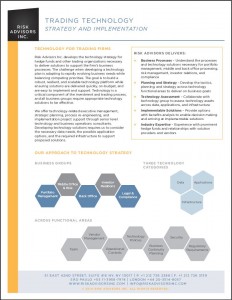
Learn more about our Technology Strategy service offerings: Trading Technology and Technology Product Strategy.